
Exemptions, Allowances, and Deductions under the Old and New Tax Regime

Exemptions, allowances, and deductions bring about huge reliefs to taxpayers as they reduce tax contingency and liability and help taxpayers take a step toward financial stability. The exemptions, allowances and deductions not only help lower taxable income but also helps them to plan taxes efficiently.
However, exemptions, allowances, and deductions under the Old & New tax regime may differ in nature. But before we get into that, let's make it clear what exemptions, allowances, and deductions mean.
Exemptions- An exemption is a relief in the form of a reduced amount of taxable income given by the law. Exemptions, as stated by the Income Tax Act, are income that is not a part of total income that is taxable under the law.
Allowances- Allowances refer to the financial gains offered to the employees by their employers in addition to the basic pay. Examples of allowances include dearness allowance, entertainment allowance, overtime allowance, etc. Allowances may be taxable, partly taxable, or non-taxable.
Deductions- Deductions in tax can be understood as the amount that an employee can claim to reduce tax liability. The deduction can be in the form of various investments, for instance, investment in EPF, NPS, etc.
Old vs New Tax Regime
Exemptions, allowances, and deductions under the Old and the New tax regime are different from each other. Not all exemptions, allowances, and deductions are available under both of the tax regimes. It is to be noted that if one of the two tax regimes, i.e. Old tax regime or New tax regime is not opted by the employee, the taxes will automatically be computed under the New tax regime by default.
But how does one decide which is better- The old tax regime or the New tax regime?
To answer this, let's think from a taxpayer's point of view. What is the utmost objective of a taxpayer? It is natural to minimize tax liabilities. So, he/she has to decide which tax regime, Old or New, would help them save taxes and reduce tax liability. To achieve this, a detailed comparison of exemptions, allowances, and deductions under the Old & New tax regime must be conducted.
Few exemptions and deductions offered by the Old tax regime-
-
- HRA- House Rent Allowance
-
- Deduction of ₹50,000 available to salaried employees
-
- TA- Travel Allowance
-
- Deductions available under Section 80TTA/80TTB Entertainment allowance deduction
-
- Deduction on interest paid on home loan
-
- Deduction of ₹15000 permissible from family pension- Section 57
-
- Tax-saving investment deductions under Chapter VI-A (80C,80D, 80E,80CCC, 80CCD, 80D, 80DD, 80DDB,, 80EE, 80EEA, 80EEB, 80G, 80GG, 80GGA, 80GGC, 80IA, 80-IAB, 80-IAC, 80-IB, 80-IBA, etc) (Except, deduction under Section 80CCD(2)—employers contribution to NPS, and Section 80JJA)
Few exemptions offered by New tax regime-
-
- Educational scholarship
-
- Income from agriculture
-
- Income obtained from Life Insurance
-
- VRS up to ₹5 lakhs
-
- Death/Retirement benefits
-
- Leave encashment on retirement
-
- Retrenchment compensation
Lets understand more about exemptions, allowances and deductions under Old tax regime and New tax regime from the table below.
List of exemptions, allowances and under Old tax regime and New tax regime:
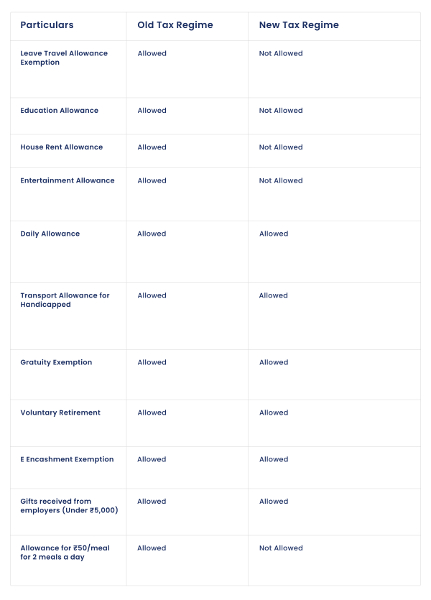
The table above represents the exemptions and allowances under the Old tax regime and the New tax regime. The table will be beneficial to taxpayers who are in a dilemma over what to choose: old tax regime or new tax regime. Let us further look into the table below to compare and contrast deductions under the Old tax regime and the New tax regime.
List of deductions under the Old tax regime and New tax regime:
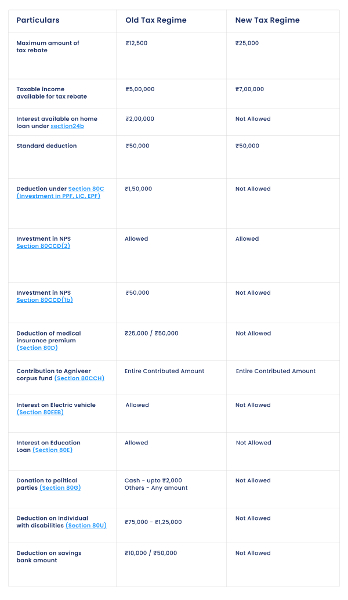
What to choose: Old tax regime or New tax regime?
The exemptions, allowances and deductions under the Old tax regime and the New tax regime differ from each other. While choosing which tax regime to opt for, a number of things must be kept in mind. For instance, the new tax regime provides lower tax slab rates. At the same time, the old tax regime allows a taxpayer to claim a number of exemptions, allowances and deductions. Logically, the option which helps a taxpayer minimise tax liability, must be chosen.
Frequently asked questions
Which tax regime is better, old or new?
The tax regime that would let the taxpayer reduce tax liabilities will be the better tax regime.
Can I switch between the old tax regime and the new tax regime?
Taxpayers are provided with the flexibility to switch between the old tax regime and the new tax regime every financial year.
Conclusion
Through this blog, PensionBox attempts at providing all important information regarding the old tax regime and the new tax regime and let the taxpayer make ideal decisions considering the exemptions, allowances and deductions under the old tax regime and the new tax regime.
2,00,000+ Stories
Hope they inspires you as well.

their NPS stories for a golden retirement.







PensionBox simplifies the National Pension System(NPS), the government's pension scheme for private employees both for retail users and HRs/companies.
If you don’t have an NPS account, you can simply open your pension account within 2 minutes and if you have NPS PRAN already, you will be able track, invest and manage everything free of charge with best user experience.
We never touch or hold your money directly, your investments go safely to your chosen pension fund through approved channels.
We are built with Zerodha as POP , ensuring transparency, data security, and peace of mind. Your retirement savings are protected by regulation and secured by technology.
That’s why, PensionBox brings transparency, zero charges, timely support and freedom to select any pension fund so that you get the best experience investing in NPS & be better future ready.
That’s not it, we help you & your company together to maximise contribution and tax savings with minimal charges & best user experience.
If you are an existing zerodha user then you get a fast login or sign up using kite ID.
Once you are onboarded with kite ID, you get free access to
- Open NPS in 2 minutes
- Track existing NPS
- POP shift or CRA shifting
- Invest in one time or create SIP in NPS
- Withdraw NPS requests & instant withdraw tier 2
- Create your dream retirement plan
- Open NPS Vatsalya for your kid
- Share with HR (To unlock more tax benefits)
- Employer Contribution:
- Contributions made by your employer to your NPS account are tax-free up to 14% of your basic salary under Section 80CCD(2). Do connect us with your HR to enable this for you.
Tax Benefits in Old Tax Regime - Self-Contribution:
- Deduction up to ₹1.5 lakh under Section 80C.
- Additional deduction of ₹50,000 under Section 80CCD(1B) — exclusive to NPS investments!
- This allows you to claim a total deduction of up to ₹2 lakh every year on your NPS contributions.
- Employer Contribution:
- Contributions made by your employer to your NPS account are tax-free up to 10% of your basic salary (Basic + DA) under Section 80CCD(2). Do connect us with your HR to enable this for you.
- This is over and above your personal deduction limits, giving you extra tax efficiency.
Feel free to book a free call to learn more about NPS, NPS Vatsalya, Corporate NPS & PensionBox or contact the support team.