
Financial Year and Assessment Year

Knowledge of the finances is extremely important. Terms like Financial Year and Assessment year play a vital role in the financial aspect of an individual's life. While planning finances, a taxpayer requires the knowledge of what financial and assessment year is so that he can be wholly and completely informed and make decisions that are in his best interests.
If somebody's concept of financial year and assessment year is not clear and uses the terms incorrectly, it can change the entire credibility of the point they are trying to make. It must be clear to all readers that financial year and assessment year are not the same things, and cannot be used interchangeably. While filing an income tax return (ITR), if you do not understand what the financial year and assessment year are, you may face several problems.
What is the Financial Year?
The financial year is the year in which you have earned your income. It starts on April 1st of each year on the calendar and ends on March 31st of the next year on the calendar. Abbreviated as FY, Financial Year is an extremely important term. In the financial year, taxpayers must calculate estimate, and plan taxes. However it is the assessment year, that is next year, when you file ITR.
Let's understand this better using dates
-
- The income you earned from 1st April 2022 to 31st March 2023 is the income earned in the current Financial Year (FY) 2022-23. And,
-
- Any income earned by you for the period starting from 1st April 2023 to 31st March 2024 can be simply stated as income earned in the Financial Year (FY) 2023-24.
What is Assessment Year?
The money or income that you earn in a financial year is taxed during the assessment year. Under the Income-tax Act, 1961 (replaced from 1 April 2026 by the Income-tax Act, 2025, which uses a single 'tax year' instead), it is the assessment year in which you are mandated to file your income tax return (ITR). The assessment year is regarded as the year that immediately succeeds the financial year, meaning that the Assessment year is the year that comes after the Financial year.
Let's understand this better using dates.
-
- In the Assessment Year 2023-24, income earned in the current Financial Year 2022-23 (i.e. from April 1, 2022, to March 31, 2023) will be considered taxable (i.e. from 1st April 2023 to 31st March 2024).
-
- In the Assessment Year 2024-25, income earned in Financial Year 2023-24 (i.e. from April 1, 2023, to March 31, 2024) will be considered taxable (i.e. from 1st April 2024 to 31st March 2025).
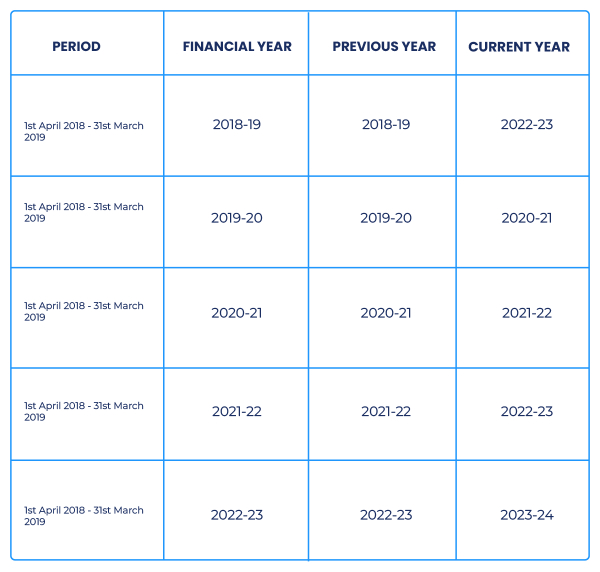
Financial Years and Assessment Years in India over the years.
The table below depicts the financial years and assessment years in India in recent years
What is the difference between a Financial Year (FY) and an Assessment Year (AY)?
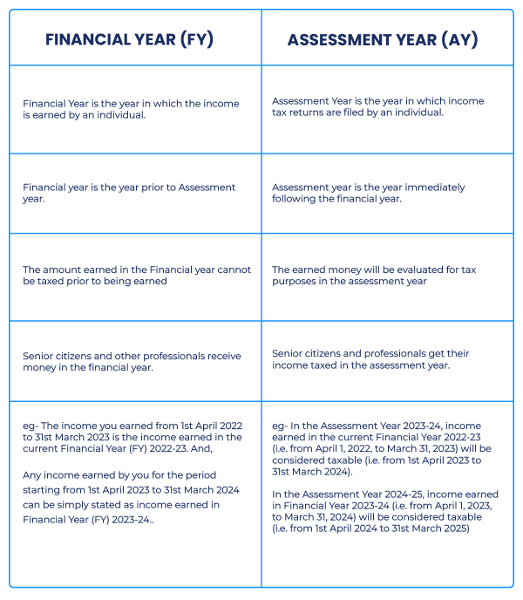
The financial year is the year in which a person earns their income or receives money for tax. On the other hand, the Assessment year is the year when the income earned in the financial year is taxed.
For instance, the financial year beginning on April 1, 2023, and ending on March 31, 2024, is called Financial Year 2023-24. The assessment year starts after the financial year ends, so AY 2024-25 will be the assessment year for FY 2023-24.
Let us understand the differences between FY and AY more clearly.
Why does an ITR form have an Assessment Year?
A question might arise in the taxpayers' minds why does an ITR form have an Assessment Year? Assessment year is the year in which the income earned by an individual in the financial year is taxed and assessment year follows the financial year. Naturally, an income cannot be taxed before it is earned. A financial year is a long year with many ups and downs. Circumstances keep changing before the entire annual income has been earned. Hence, an ITR form must have an Assessment year.
PensionBox makes it easy to understand important financial terms that must be known by all taxpayers to decide what is best for them. A detailed article about the financial year and assessment year has been provided above for the readers at PensionBox!
2,00,000+ Stories
Hope they inspires you as well.

their NPS stories for a golden retirement.







PensionBox simplifies the National Pension System(NPS), the government's pension scheme for private employees both for retail users and HRs/companies.
If you don’t have an NPS account, you can simply open your pension account within 2 minutes and if you have NPS PRAN already, you will be able track, invest and manage everything free of charge with best user experience.
We never touch or hold your money directly, your investments go safely to your chosen pension fund through approved channels.
We are built with Zerodha as POP , ensuring transparency, data security, and peace of mind. Your retirement savings are protected by regulation and secured by technology.
That’s why, PensionBox brings transparency, zero charges, timely support and freedom to select any pension fund so that you get the best experience investing in NPS & be better future ready.
That’s not it, we help you & your company together to maximise contribution and tax savings with minimal charges & best user experience.
If you are an existing zerodha user then you get a fast login or sign up using kite ID.
Once you are onboarded with kite ID, you get free access to
- Open NPS in 2 minutes
- Track existing NPS
- POP shift or CRA shifting
- Invest in one time or create SIP in NPS
- Withdraw NPS requests & instant withdraw tier 2
- Create your dream retirement plan
- Open NPS Vatsalya for your kid
- Share with HR (To unlock more tax benefits)
- Employer Contribution:
- Contributions made by your employer to your NPS account are tax-free up to 14% of your basic salary under Section 80CCD(2). Do connect us with your HR to enable this for you.
Tax Benefits in Old Tax Regime - Self-Contribution:
- Deduction up to ₹1.5 lakh under Section 80C.
- Additional deduction of ₹50,000 under Section 80CCD(1B) — exclusive to NPS investments!
- This allows you to claim a total deduction of up to ₹2 lakh every year on your NPS contributions.
- Employer Contribution:
- Contributions made by your employer to your NPS account are tax-free up to 10% of your basic salary (Basic + DA) under Section 80CCD(2). Do connect us with your HR to enable this for you.
- This is over and above your personal deduction limits, giving you extra tax efficiency.
Feel free to book a free call to learn more about NPS, NPS Vatsalya, Corporate NPS & PensionBox or contact the support team.