
Learn gratuity under the Income Tax Act with PensionBox

Who does not aspire to earn extra income? Even a little extra makes a significant difference in the lives of the middle class. It helps them save more for retirement. So, as an acknowledgment and appreciation for your service, employers provide their employees with a financial reward in the form of a gratuity. Gratuity is administered by the Payment of Gratuity Act, of 1972. Individuals are drawn towards gratuity because it is tax-exempt under Section 10 of the Income Tax Act.
In this article, we shall decode gratuity under the Income Tax Act and its various aspects. For full insights, read the article till the end.
What is gratuity?
Gratuity is a monetary reward provided to the employee by the employer to show appreciation and thankfulness for the services provided by the employee.
Gratuity is generally paid when:
-
- an employee retires
-
- an employee resigns
-
- an employee is dismissed after they have completed the minimum number of years of service, as mandated by the employer.
How do I calculate gratuity?
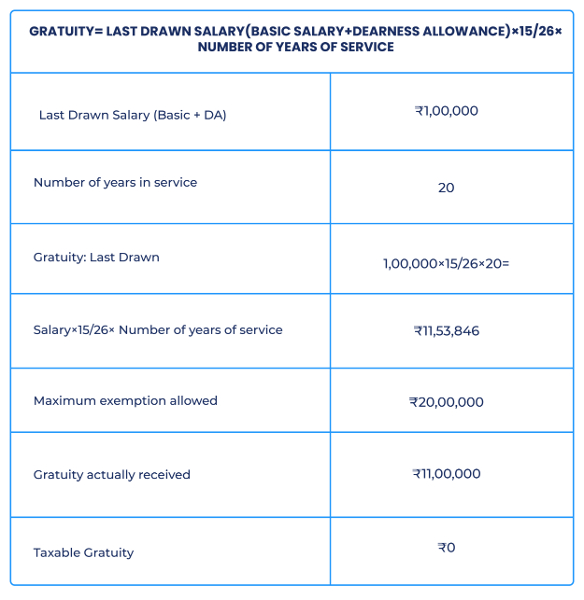
To calculate gratuity, you can use the formula given below.

It must be noted that, as per the latest amendment, the maximum amount of gratuity payable under the Payment of Gratuity Act is capped at Rs. 20 lakhs.
Let us try to understand this through an example,
Let's assume that Akriti is an employee, and her last drawn salary (that includes Basic and DA) was ₹1,00,000 per month. She was in service for a continuous period of 20 years. Let's try and calculate the gratuity received by her.
Who is entitled to claim gratuity under the Income Tax Act?
The eligibility to claim gratuity under the Income Tax Act is as follows:
-
- Any individual who is working as an intern and is receiving a stipend is not entitled to gratuity. Only those employees who are working full time and receiving wages are entitled to gratuity.
-
- The employee must have served for a minimum of 5 years to claim gratuity. However, in cases of death or sudden disability, the 5-year rule does not apply. Fixed-term employees become eligible after 1 year of service under the Code on Social Security, 2020.
Who is an employee?
As we have seen, an employee can claim a tax exemption on gratuity under the Income Tax Act under the specified provisions. But who is an employee? When can an individual be called an “employee” to claim tax exemption on gratuity under the Income Tax Act?
An employee is- Any working individual—for instance, working in a shop, industry, factory, coal mine, etc.–– who is working full-time and receiving wages can be called an “employee,” and is entitled to claim a tax exemption gratuity under the Income Tax Act.
When can an employee claim gratuity under the Income Tax Act?
-
- An employee can claim gratuity at retirement.
-
- An employee can claim gratuity on superannuation.
-
- An employee can claim gratuity on resignation.
-
- An employee can claim gratuity on termination.
-
- Gratuity can be claimed on death or impairment due to an accident or any other issue.
-
- An employee can claim gratuity on layoff.
-
- An employee can claim gratuity if he opts for the VRS (Voluntary Retirement Scheme).
Taxation of Gratuity
The taxation system for gratuities differs from employee to employee. Let's understand more about this.
-
1. Government Employee: For a government employee, including employees of legal corporations, local authorities, and institutions accustomed to a Central or State Act, gratuity is fully exempt from tax.
-
2. Non-Government Employee: For a non-government employee covered under the Payment of Gratuity Act, the tax exemption can be calculated based on the formula: Exemption = (15/26) × Last drawn salary× Number of years of service. The maximum exemption permitted under this provision is ₹20 lakh.
-
3. Non-Covered Employees: For employees not covered under the Payment of Gratuity Act, the tax exemption varies from the previous. Here, it is the least of the following:
a. For each year completed in service, half of the month's salary hinged on the average salary of the last 10 months immediately preceding the month of retirement. b. Rs. 20 lakhs c. Actual gratuity received
To ensure compliance with the Income Tax Act, an individual must understand the meaning and aspects of gratuity. Gratuity serves as a great monetary benefit, but understanding the taxation system of gratuity is equally important to plan retirement efficiently. And if you come across any confusion or problems in your retirement planning, PensionBox is always there to make your retirement planning experience great.
Frequently asked questions
How is gratuity calculated for an employee?
Gratuity is calculated using the formula: Gratuity = (15/26) x Last drawn salary x Number of years of service. The last drawn salary includes the Basic and Dearness Allowance (DA). The Payment of Gratuity Act, 1972, caps the maximum amount payable at Rs. 20 lakhs.
2,00,000+ Stories
Hope they inspires you as well.

their NPS stories for a golden retirement.







PensionBox simplifies the National Pension System(NPS), the government's pension scheme for private employees both for retail users and HRs/companies.
If you don’t have an NPS account, you can simply open your pension account within 2 minutes and if you have NPS PRAN already, you will be able track, invest and manage everything free of charge with best user experience.
We never touch or hold your money directly, your investments go safely to your chosen pension fund through approved channels.
We are built with Zerodha as POP , ensuring transparency, data security, and peace of mind. Your retirement savings are protected by regulation and secured by technology.
That’s why, PensionBox brings transparency, zero charges, timely support and freedom to select any pension fund so that you get the best experience investing in NPS & be better future ready.
That’s not it, we help you & your company together to maximise contribution and tax savings with minimal charges & best user experience.
If you are an existing zerodha user then you get a fast login or sign up using kite ID.
Once you are onboarded with kite ID, you get free access to
- Open NPS in 2 minutes
- Track existing NPS
- POP shift or CRA shifting
- Invest in one time or create SIP in NPS
- Withdraw NPS requests & instant withdraw tier 2
- Create your dream retirement plan
- Open NPS Vatsalya for your kid
- Share with HR (To unlock more tax benefits)
- Employer Contribution:
- Contributions made by your employer to your NPS account are tax-free up to 14% of your basic salary under Section 80CCD(2). Do connect us with your HR to enable this for you.
Tax Benefits in Old Tax Regime - Self-Contribution:
- Deduction up to ₹1.5 lakh under Section 80C.
- Additional deduction of ₹50,000 under Section 80CCD(1B) — exclusive to NPS investments!
- This allows you to claim a total deduction of up to ₹2 lakh every year on your NPS contributions.
- Employer Contribution:
- Contributions made by your employer to your NPS account are tax-free up to 10% of your basic salary (Basic + DA) under Section 80CCD(2). Do connect us with your HR to enable this for you.
- This is over and above your personal deduction limits, giving you extra tax efficiency.
Feel free to book a free call to learn more about NPS, NPS Vatsalya, Corporate NPS & PensionBox or contact the support team.