
PensionBox differentiates between Updated return and Revised return

We are humans. Humans make errors. Humans forget things. Taxpayers are humans, and therefore taxpayers also make errors and forget things. There may come a time when taxpayers may be required to change their income tax return filing, even though they have already submitted it. This situation can arise due to multiple reasons. What must a taxpayer do in such a situation? There are two choices available to them.
-
- They can opt to file an updated return.
-
- Or, they can opt to submit a revised return.
Whether you choose to file an updated return or submit a revised one, you will be required to amend the tax documents you filed previously. So, what makes one different from the other? In this blog, we will dive deep into understanding the important differences between an updated return and a revised return.
To ensure tax compliance and efficient and accurate income tax filings, taxpayers must understand that an updated return and a revised return are not the same thing. Let's understand the meaning of both terms.
What is an updated return?
An updated return can be defined as an amended return that is filed to rectify errors made in the tax filings or provide additional information after the original return has been filed with the tax authorities. An updated return is generally filed in cases where the taxpayer has made errors in the tax filings or left out certain income or deductions from the returns they filed before.
Features and Characteristics of an Updated Return
Rectification of errors-
The updated return has the main objective of rectifying errors made by the taxpayer on the original return. The errors can take different forms.
-
- the taxpayer may have entered incorrect personal information
-
- the taxpayer may have left out an income,
-
- the taxpayer may have inaccurately reported the deductions.
To provide additional information-
An updated return may also be filed by a taxpayer to provide additional information that was not added in the original filing. For instance, they may have received a late or updated tax form after filing their original return, so they may need to submit an updated return to record this new information.
Deadline for filing an updated return-
Generally, there isn't a deadline to file an updated return. However, it is recommended to file the updated return at the earliest. If you fail to rectify the errors, it could lead to penalties or interest charges against you.
Procedure for filing an updated return-
An updated return can be filed by a taxpayer simply by finishing and submitting IRS Form 1040X (for federal returns) or a similar form for their state tax authority. In this form, there are sections where taxpayers can provide explanations of the changes they are willing to make and support the claim with appropriate documentation.
What effect does an updated return have on the original return?
When you file an updated return, it wholly replaces the originally filed return. In this case, the tax officials carefully review the updated return and thereby make any changes or adjustments required to the taxpayer's tax liability, refunds, or payments.
What is a revised return?
A revised return is different from an updated return and can be described as a corrected return that has been filed by the taxpayer's own free will. It is usually filed because of the emergence of new information or in response to new changes. It differs from an updated return in the manner that an updated return is generally used to correct errors, while a revised return is filed by a taxpayer to make necessary changes in case a certain tax situation arises after the return had been originally filed.
Features and Characteristics of a Revised Return
-
1. Making voluntary changes- Filing a revised return is a voluntary action taken by the taxpayer to make changes to their original return. As opposed to an updated return, you are not obligated to file a revised return until and unless there arises a certain situation in which you may be required to make changes.
-
2. Deadline for filing a revised return- There is no such deadline for filing a revised return, similar to an updated return. Taxpayers may choose to file a revised return whenever they find any mistakes in the filing, or when they want to make changes to the originally filed return.
-
3. Procedure of filing a revised return- The procedure for filing a revised return is the same as that for filing an original return. Taxpayers are required to fill out the tax forms for the particular tax year, make the changes they desire, and submit the revised return to the concerned tax official.
What effect does a revised return have on the original return?
Once you file a revised return, it completely replaces the original return. The tax officials will carefully review the revised return and make changes to the taxpayer's tax liability, refunds, or payments based on the information provided by the taxpayer.
The difference between an updated return and a revised return
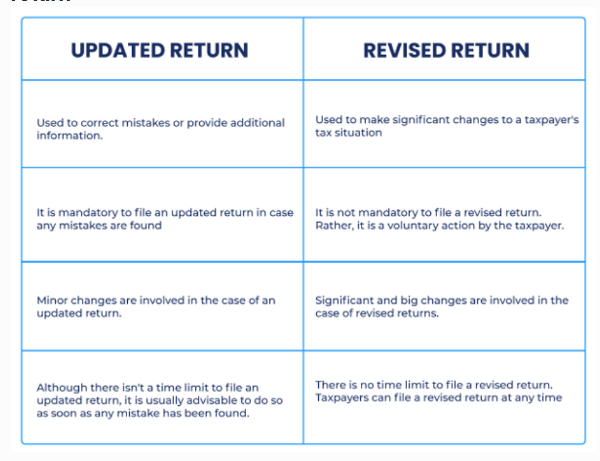
For any individual who is also a taxpayer, knowledge of financial terms is essential. Hence, one must possess knowledge of what an updated return and a revised return are. PensionBox aims to provide you with all the necessary information about your finances so you can make an informed decision.
Frequently asked questions
What is the difference between an updated return and a revised return?
An updated return is filed to correct errors or add information to an already submitted tax return, such as incorrect personal details, omitted income, or misreported deductions. A revised return, on the other hand, is a voluntary correction made due to new information or changes in tax situations after the original return has been filed. Both types replace the original return, but they serve different purposes.
How do I file an updated or revised return?
To file an updated return, complete and submit IRS Form 1040X (or a similar state tax form) with explanations and supporting documentation for the changes. To file a revised return, simply fill out the tax forms for the relevant tax year, make the necessary changes, and submit it to the appropriate tax authority. Both processes ensure that your tax liability, refunds, or payments are adjusted based on the new information provided.
2,00,000+ Stories
Hope they inspires you as well.

their NPS stories for a golden retirement.







PensionBox simplifies the National Pension System(NPS), the government's pension scheme for private employees both for retail users and HRs/companies.
If you don’t have an NPS account, you can simply open your pension account within 2 minutes and if you have NPS PRAN already, you will be able track, invest and manage everything free of charge with best user experience.
We never touch or hold your money directly, your investments go safely to your chosen pension fund through approved channels.
We are built with Zerodha as POP , ensuring transparency, data security, and peace of mind. Your retirement savings are protected by regulation and secured by technology.
That’s why, PensionBox brings transparency, zero charges, timely support and freedom to select any pension fund so that you get the best experience investing in NPS & be better future ready.
That’s not it, we help you & your company together to maximise contribution and tax savings with minimal charges & best user experience.
If you are an existing zerodha user then you get a fast login or sign up using kite ID.
Once you are onboarded with kite ID, you get free access to
- Open NPS in 2 minutes
- Track existing NPS
- POP shift or CRA shifting
- Invest in one time or create SIP in NPS
- Withdraw NPS requests & instant withdraw tier 2
- Create your dream retirement plan
- Open NPS Vatsalya for your kid
- Share with HR (To unlock more tax benefits)
- Employer Contribution:
- Contributions made by your employer to your NPS account are tax-free up to 14% of your basic salary under Section 80CCD(2). Do connect us with your HR to enable this for you.
Tax Benefits in Old Tax Regime - Self-Contribution:
- Deduction up to ₹1.5 lakh under Section 80C.
- Additional deduction of ₹50,000 under Section 80CCD(1B) — exclusive to NPS investments!
- This allows you to claim a total deduction of up to ₹2 lakh every year on your NPS contributions.
- Employer Contribution:
- Contributions made by your employer to your NPS account are tax-free up to 10% of your basic salary (Basic + DA) under Section 80CCD(2). Do connect us with your HR to enable this for you.
- This is over and above your personal deduction limits, giving you extra tax efficiency.
Feel free to book a free call to learn more about NPS, NPS Vatsalya, Corporate NPS & PensionBox or contact the support team.