
Retirement Gratuity vs. Pension: Key Differences and Considerations

Retirement is a significant milestone in an individual's life, and financial security during this phase is crucial. In India, two common terms associated with retirement benefits are gratuity and pension. While both are designed to provide financial support to employees after retirement, they differ in various aspects, such as eligibility, payment structure, and taxation. In this article, we will discuss the key differences between gratuity and pensions, their taxation status, and other important aspects that every employee should be aware of.
Gratuity
Gratuity is a payment made by an employer to an employee as a reward for their service. It is a legal entitlement under the Payment of Gratuity Act, 1972, which applies to all establishments employing 10 or more employees. To be eligible for gratuity, an employee must have completed at least five years of continuous service with the same employer. The amount of gratuity is calculated based on the employee's last drawn salary and the number of years of service. The formula is as follows:
Gratuity = (15 * last drawn salary * number of years of service) / 26
For example, if an employee’s last drawn salary is INR 50,000 and they have served for 10 years, their gratuity would be about INR 2,88,462. Gratuity is paid in lump sum, either on retirement, resignation, death, or permanent disablement of the employee. In case of death, the gratuity is paid to the nominee of the employee.
Pension

A pension is a retirement plan that provides regular payments to a person after they retire. The payments are typically made from a fund that has been accumulated during the person’s working years.
There are two main types of pensions: defined benefit plans and defined contribution plans. Pensions are typically funded by the employer, but employees may also make contributions. The amount of the employer’s contribution is usually based on a formula that takes into account the employee’s salary and years of service. Pensions can be a valuable source of income in retirement. However, they are not always guaranteed. In some cases, employers may go bankrupt or be unable to make the required contributions to the pension plan.
Comparison Table Between Both:
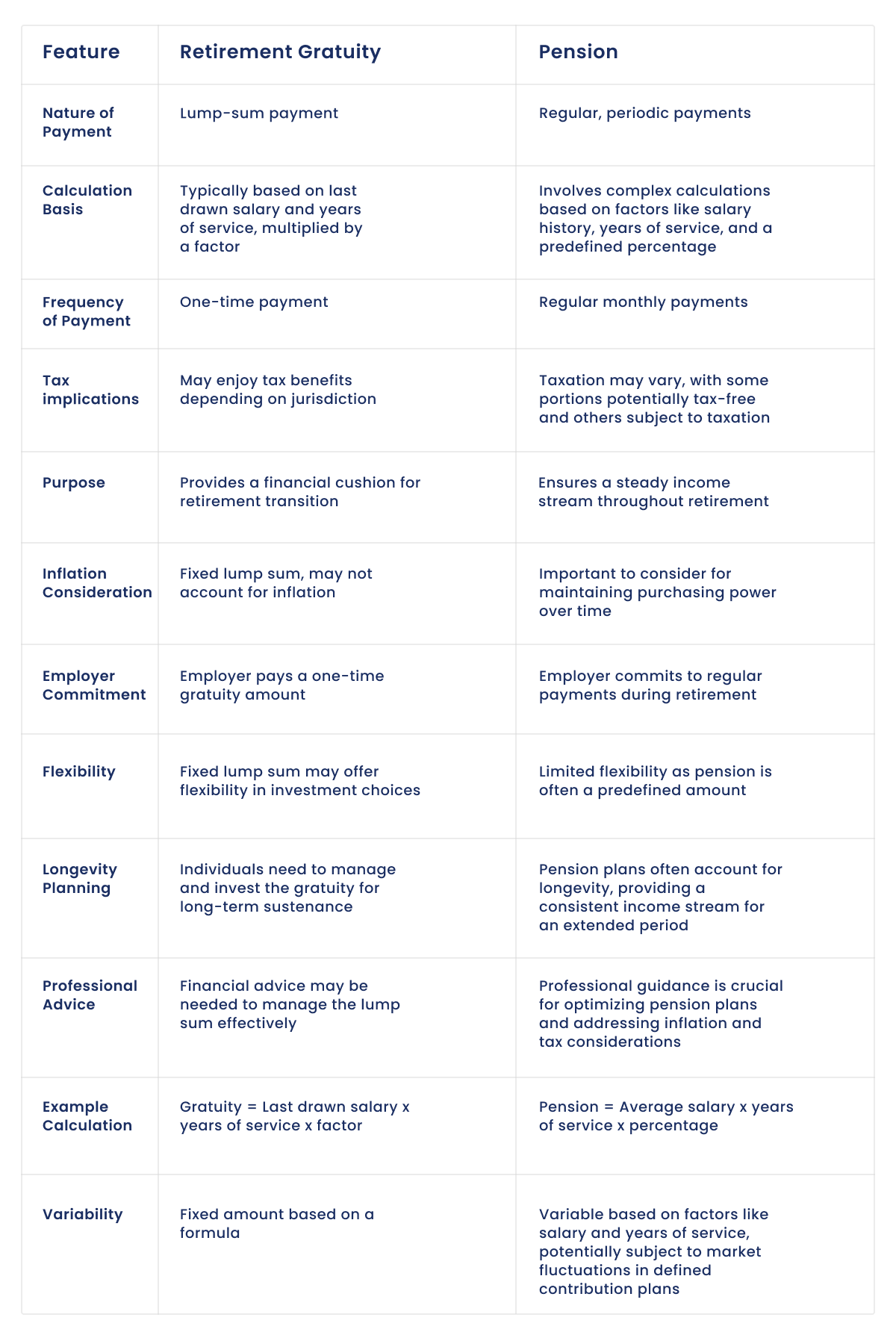
Key Differences Between Gratuity and Pension
1. Payment Structure:
Gratuity is a one-time lump sum payment made to an employee upon retirement, resignation, death, or permanent disablement. In contrast, a pension is a regular payment made to a retiree for the rest of their life.
2. Eligibility:
To be eligible for gratuity, an employee must have completed at least five years of continuous service with the same employer. However, there are no such eligibility criteria for a pension. An employee can start receiving a pension as soon as they retire, regardless of the length of their service.
3. Taxation:
Gratuity is taxable in India, but there are some exemptions. The amount of gratuity that is taxable depends on the following factors:
If the gratuity is received from a former employer, the amount exempt from tax is the least of the following:
- INR 20 lakh
- 15 days’ salary for each completed year of service
- Gratuity actually received
If the gratuity is received from a current employer, the amount exempt from tax is the least of the following:
- INR 10 lakh
- 15 days’ salary for each completed year of service
- Gratuity actually received
Pension, on the other hand, is taxable as per the individual's income tax slab. However, if the pension is received from a recognized provident fund, the first INR 1.5 lakh is tax-exempt.
4. Guarantee:
Gratuity is a guaranteed payment made by the employer to the employee upon completion of the eligibility criteria. However, a pension is not guaranteed, and there is a risk that the employer may not be able to make the required contributions to the pension fund.
5. Investment Options:
Gratuity does not offer any investment options, as it is a one-time payment. However, pensions offer various investment options, such as fixed income, equity, and balanced funds, depending on the type of pension plan.
Considerations for Individuals:
1. Financial Planning:
Individuals need to consider both retirement gratuity and pension in their overall financial planning. While gratuity provides an initial lump sum, pension ensures a regular income stream throughout retirement.
2. Inflation:
It's essential to account for inflation when evaluating the adequacy of pension payments. A fixed pension amount may lose its purchasing power over time, emphasizing the importance of having a pension plan that incorporates inflation adjustments.
3. Tax Efficiency:
Understanding the tax implications of both retirement gratuity and pension is crucial for effective tax planning during retirement. Seek advice from financial professionals to optimize your tax strategy.
4. Employer Policies:
Different employers may have varying policies regarding retirement benefits. Employees need to be well-informed about their company's policies and consider these factors when making retirement decisions.
5. Longevity:
With increasing life expectancies, individuals must consider the length of their retirement and ensure that their retirement package adequately covers their financial needs throughout their golden years.
Wrapping Up
Gratuity and pension are both important retirement benefits that provide financial support to employees after they retire. While a gratuity is a one-time lump sum payment made to an employee upon completion of the eligibility criteria, a pension is a regular payment made to a retiree for the rest of their life.
Gratuity is taxable in India, but there are some exemptions, whereas pension is taxable as per the individual's income tax slab. Understanding the differences between gratuity and pension is crucial for employees to make informed decisions about their financial future.
2,00,000+ Stories
Hope they inspires you as well.

their NPS stories for a golden retirement.







PensionBox simplifies the National Pension System(NPS), the government's pension scheme for private employees both for retail users and HRs/companies.
If you don’t have an NPS account, you can simply open your pension account within 2 minutes and if you have NPS PRAN already, you will be able track, invest and manage everything free of charge with best user experience.
We never touch or hold your money directly, your investments go safely to your chosen pension fund through approved channels.
We are built with Zerodha as POP , ensuring transparency, data security, and peace of mind. Your retirement savings are protected by regulation and secured by technology.
That’s why, PensionBox brings transparency, zero charges, timely support and freedom to select any pension fund so that you get the best experience investing in NPS & be better future ready.
That’s not it, we help you & your company together to maximise contribution and tax savings with minimal charges & best user experience.
If you are an existing zerodha user then you get a fast login or sign up using kite ID.
Once you are onboarded with kite ID, you get free access to
- Open NPS in 2 minutes
- Track existing NPS
- POP shift or CRA shifting
- Invest in one time or create SIP in NPS
- Withdraw NPS requests & instant withdraw tier 2
- Create your dream retirement plan
- Open NPS Vatsalya for your kid
- Share with HR (To unlock more tax benefits)
- Employer Contribution:
- Contributions made by your employer to your NPS account are tax-free up to 14% of your basic salary under Section 80CCD(2). Do connect us with your HR to enable this for you.
Tax Benefits in Old Tax Regime - Self-Contribution:
- Deduction up to ₹1.5 lakh under Section 80C.
- Additional deduction of ₹50,000 under Section 80CCD(1B) — exclusive to NPS investments!
- This allows you to claim a total deduction of up to ₹2 lakh every year on your NPS contributions.
- Employer Contribution:
- Contributions made by your employer to your NPS account are tax-free up to 10% of your basic salary (Basic + DA) under Section 80CCD(2). Do connect us with your HR to enable this for you.
- This is over and above your personal deduction limits, giving you extra tax efficiency.
Feel free to book a free call to learn more about NPS, NPS Vatsalya, Corporate NPS & PensionBox or contact the support team.