
What Is Fiscal Year-End? Definition and vs. Calendar-Year End

Fiscal year and calendar year are two very important terms in finances. Any individual filing taxes requires the knowledge of the two terms - fiscal year and calendar year. Having financial knowledge always keeps us a step ahead in life.
Both the fiscal year and calendar year have 365 days. However, they are not the same thing. One cannot use fiscal year and calendar year interchangeably. Though both have 12 months, the start dates and end dates for the fiscal year and calendar year are different. In this blog, we aim to make the concepts of fiscal year and calendar year a little more clear for our readers. Read till the end for complete knowledge.
What is a fiscal year?
A fiscal year can be understood as the completion of any one-year or 365-day period in which the financial estimates and financial statements are prepared by a salaried individual or business. This means that an organization's fiscal year is different from its calendar year.
Fiscal years are used by
The fiscal year is important in the sense that companies and businesses are required to choose a fiscal year-end and generally, they do that at the time when they are setting up their company or business. The company then is required to hold onto it every year. This allows consistency in accounting data.
Important things to keep in mind about Fiscal Year-
-
- Fiscal year-end marks the completion of one year, i.e. 12 months or 365 days
-
- For a company or business whose fiscal year is the same as the calendar year, this would mean that that company's fiscal year would end on 31st December.
-
- Companies and businesses are given the liberty to decide the fiscal year-end for themselves in best their interests.
What is a calendar year?
The fiscal year and calendar year are similar in the manner that both consist of a consecutive 365-day or 12-month period. However, both differ in the manner that while the fiscal year differs for different companies as per what suits their needs, the calendar year is the same for everyone. It starts on the 1st of January and ends on the 31st of December.
Fiscal year-end vs. Calendar year-end
As we know the fiscal year and calendar year both comprise 365 days or 12 months. Companies may choose to have the fiscal year the same as the calendar year, i.e. their fiscal year ends on 31st December.
However, most companies choose their fiscal year-end depending on the needs of the company. Let's understand this using an example. X is a company that sells winter wear. Now this company would not want its fiscal year to be the same as its calendar year. Why so? This would be because the sales of winter wear are maximum during winter. 31st December collides with this as winter is going on at that time when customers are buying winter wear on a large scale. Assuming that the company had chosen 31st December as the fiscal year-end, it might have faced problems generating the financial statements for the year and in other domains as well. Hence, the company would rather avoid these hassles and choose let's say 31st March as fiscal year-end, as by 31st March, sales of winter wear will drop.
Choosing a company's fiscal year-end is a crucial decision. This is because the company cannot be changed year to year. Once chosen, the fiscal year-end remains the same for the company. However, one must take a sharp mental note that a company's fiscal year-end does not mean that the due date on taxes will change. It is going to be the same for all.
Differences between Calendar Year and Fiscal Year
The table below shows the key differences between a calendar year and a fiscal year.
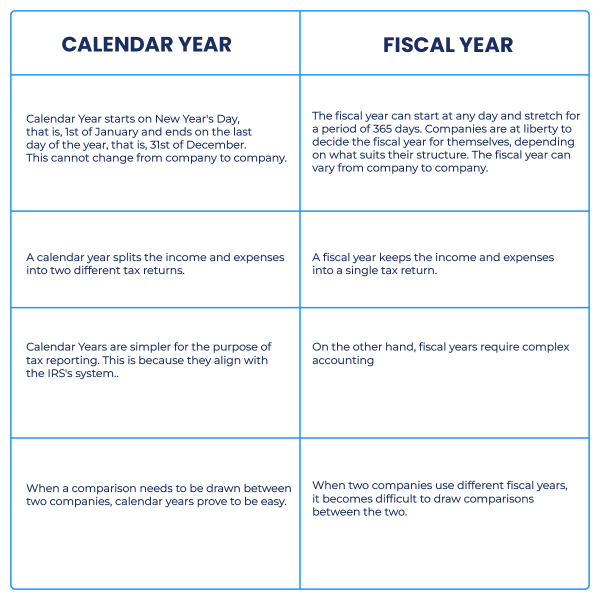
What happens at Fiscal year-end?
At fiscal year-end, the business or company is required to review its books. It has to review all the transactions made during the fiscal year, verify the data, and go through the calculations of financial data, for instance, expenditure, revenue, income, investment, and others.
How should a company choose its fiscal year-end?
A company must choose its fiscal year end by focusing on the situation at which time of the year their business will flourish the most. Those businesses that are seasonal use this method to choose their fiscal year-end. They calculate when they are going to receive maximum profits, and after that, they can set up their fiscal year-end.
The fiscal year can be understood as the completion of any one-year or 365-day period in which the financial estimates and financial statements are prepared by a salaried individual, business, or company. It differs from calendar year because calendar year is fixed for every company but fiscal year may change from company to company. We, at PensionBox hope that our readers have gained insights about fiscal year-end and calendar year-end.
Frequently asked questions
What's the difference between a fiscal year and a calendar year?
Simply put, a calendar year always starts on January 1st and ends on December 31st. But a fiscal year can vary. It's a 12-month period a company chooses for financial planning.
Why do companies choose different fiscal year-ends?
Well, it's all about what works best for them. Take a company selling winter wear, for example. They might pick a fiscal year-end like March 31st instead of December 31st to avoid crunch times during peak sales. Remember, though, the fiscal year-end doesn't change tax deadlines for anyone.
What happens at fiscal year-end?
Businesses review all financial transactions, verify data accuracy, and recalculate key financial metrics like expenditure, revenue, and investments.
How should a company choose its fiscal year-end?
Companies should pick a fiscal year-end that aligns with their peak profitability period, especially for seasonal businesses. This ensures strategic financial planning and reporting.
2,00,000+ Stories
Hope they inspires you as well.

their NPS stories for a golden retirement.







PensionBox simplifies the National Pension System(NPS), the government's pension scheme for private employees both for retail users and HRs/companies.
If you don’t have an NPS account, you can simply open your pension account within 2 minutes and if you have NPS PRAN already, you will be able track, invest and manage everything free of charge with best user experience.
We never touch or hold your money directly, your investments go safely to your chosen pension fund through approved channels.
We are built with Zerodha as POP , ensuring transparency, data security, and peace of mind. Your retirement savings are protected by regulation and secured by technology.
That’s why, PensionBox brings transparency, zero charges, timely support and freedom to select any pension fund so that you get the best experience investing in NPS & be better future ready.
That’s not it, we help you & your company together to maximise contribution and tax savings with minimal charges & best user experience.
If you are an existing zerodha user then you get a fast login or sign up using kite ID.
Once you are onboarded with kite ID, you get free access to
- Open NPS in 2 minutes
- Track existing NPS
- POP shift or CRA shifting
- Invest in one time or create SIP in NPS
- Withdraw NPS requests & instant withdraw tier 2
- Create your dream retirement plan
- Open NPS Vatsalya for your kid
- Share with HR (To unlock more tax benefits)
- Employer Contribution:
- Contributions made by your employer to your NPS account are tax-free up to 14% of your basic salary under Section 80CCD(2). Do connect us with your HR to enable this for you.
Tax Benefits in Old Tax Regime - Self-Contribution:
- Deduction up to ₹1.5 lakh under Section 80C.
- Additional deduction of ₹50,000 under Section 80CCD(1B) — exclusive to NPS investments!
- This allows you to claim a total deduction of up to ₹2 lakh every year on your NPS contributions.
- Employer Contribution:
- Contributions made by your employer to your NPS account are tax-free up to 10% of your basic salary (Basic + DA) under Section 80CCD(2). Do connect us with your HR to enable this for you.
- This is over and above your personal deduction limits, giving you extra tax efficiency.
Feel free to book a free call to learn more about NPS, NPS Vatsalya, Corporate NPS & PensionBox or contact the support team.