
What is NPS

The National Pension System (NPS) is India's voluntary, government-backed retirement savings scheme, regulated by the Pension Fund Regulatory and Development Authority (PFRDA). You pay in through your working life, professional pension fund managers invest the money across equity and debt on your behalf, and from age 60 you take part of the corpus as a lump sum and convert the rest into a pension for life. Any Indian citizen between 18 and 70, resident or NRI, can open an account.
| NPS at a glance | |
|---|---|
| Regulator | PFRDA |
| Who can join | Indian citizens, resident or NRI, aged 18 to 70 |
| Account types | Tier I (the retirement account, locked in) and Tier II (an optional, open-access add-on) |
| Minimum to start | ₹500 to open Tier I, and ₹1,000 a year to keep it active |
| Where the money goes | Equity, corporate debt, government bonds and alternative investment funds, through a pension fund manager you choose |
| Returns | Market-linked. There is no fixed or guaranteed rate |
| Tax benefits | Sections 80CCD(1), 80CCD(1B) and 80CCD(2) |
| At retirement | Lump sum plus a compulsory annuity above certain corpus sizes — see the exit table below |
Who can open an NPS account?
Any Indian citizen aged 18 to 70 can open an NPS account, whether they are salaried, self-employed or an NRI. You need a PAN, a bank account and KYC. You get one Permanent Retirement Account Number (PRAN) for life, and it stays with you across jobs, cities and employers — you never open a second one.
Broadly there are three ways in:
- Individual (All Citizen) NPS — you open it yourself and contribute whatever you choose.
- Corporate NPS — your employer contributes to your PRAN through payroll, which unlocks an extra deduction your own contribution cannot.
- NPS Vatsalya — an account a parent or guardian opens for a child. It runs under separate rules, so do not apply anything on this page to it.
What is the difference between NPS Tier I and Tier II?
| Tier I | Tier II | |
|---|---|---|
| What it is | The actual retirement account | An optional investment add-on |
| Required? | Yes — this is the NPS account | No, and it needs an active Tier I first |
| Lock-in | Until 60, apart from the exit routes below | None — withdraw any time |
| Minimum | ₹500 to open, ₹1,000 a year to stay active | No annual minimum |
| Tax deduction | Yes, under 80CCD | No, for private-sector subscribers |
Most people only ever need Tier I. Tier II is useful if you already like your pension fund's performance and want a no-lock-in place to park money alongside it.
What are the tax benefits of NPS?
This is where NPS differs from an ordinary mutual fund, and it is worth being precise, because two of the three deductions exist only in the old tax regime.
| Section | Whose money | How much | Which regime |
|---|---|---|---|
| 80CCD(1) | Your own contribution | Up to 10% of basic + DA if salaried, or 20% of gross income if self-employed — inside the ₹1.5 lakh ceiling shared with 80C | Old regime only |
| 80CCD(1B) | Your own contribution | An extra ₹50,000, over and above the ₹1.5 lakh | Old regime only |
| 80CCD(2) | Your employer's contribution | Up to 10% of basic + DA in the old regime and 14% in the new regime | Both — the one salary deduction the new regime keeps |
Two things people miss. First, 80CCD(2) sits outside the ₹1.5 lakh limit entirely, so it stacks on top of everything else — which is why Corporate NPS is worth asking your HR about even if you already max out 80C. Second, there is an aggregate ceiling of ₹7.5 lakh a year across your employer's PF, NPS and superannuation contributions taken together; anything above it is taxed as a perquisite. (From FY 2026-27 these deductions live in Section 124 of the Income-tax Act, 2025; the limits are unchanged.)
How is your NPS money invested?
When registering in the CRA system under NPS, a subscriber selects the Pension Fund Manager (PFM) and then the scheme preference. There are multiple PFMs, two investment options — Active or Auto — and four asset classes: equity, corporate debt, government bonds and alternative investment funds. You pick the PFM first, then the investment option.
Active Choice: you decide the allocation
Here the subscriber actively chooses how the contribution is invested, based on personal preference, by giving the PFM, asset class and percentage allocation for each scheme.
The four asset classes are:
- Asset Class E — equity
- Asset Class C — corporate debt
- Asset Class G — government bonds
- Asset Class A — alternative investment funds
Three rules apply to the allocation:
- From the age of 51 onwards, the maximum permitted equity investment follows the equity allocation matrix, tapering down by the subscriber's date of birth.
- Alternative investment funds (class A) cannot exceed 5%.
- Allocation across E, C, G and A must total 100%.
Auto Choice: the lifecycle funds
Subscribers who would rather not choose an allocation can pick Auto Choice, a life-stage option that sets the allocation by age and moves it gradually towards safety as you get older. There are three:
| Lifecycle fund | Equity cap | Suits |
|---|---|---|
| LC25 — Conservative | 25% of total allocation in asset class E | Low risk appetite, or a late start |
| LC50 — Moderate | 50% | The middle path, and the default for most |
| LC75 — Aggressive | 75% | A long runway and tolerance for equity swings |
In all three, equity exposure reduces gradually as the subscriber ages.
What is the Multi-Scheme Framework, and the 100% equity option?
Until late 2025, even the most aggressive NPS option capped equity at 75%. PFRDA then introduced the Multi-Scheme Framework (MSF), which runs as an additional track alongside the traditional one under the same PRAN, and allows a genuine 100% equity allocation invested in the top 250 listed companies.
Two limits are worth knowing before you get excited: MSF takes new contributions only — a corpus already sitting in the common scheme cannot be shifted into it during the lock-in — and it is built for a long horizon. We have written the full breakdown in The 100% Equity Upgrade.
What happens to your NPS money at 60?
Normal exit opens at age 60, at superannuation, or after 15 years of subscription — though corporate subscribers reach it through retirement or superannuation only. What you can take out then depends on the size of the corpus:
| Corpus at exit | What you can take |
|---|---|
| Up to ₹8 lakh | The entire corpus as a lump sum |
| ₹8 lakh to ₹12 lakh | Your choice: up to ₹6 lakh as a lump sum with the balance as an annuity or a systematic withdrawal over at least 6 years — or up to 80% as a lump sum with at least 20% annuitised |
| Above ₹12 lakh | Up to 80% as a lump sum, with at least 20% used to buy an annuity |
These are the non-government rules, after the PFRDA exit amendment. Government-sector subscribers still annuitise 40% on normal exit. Premature exit is also possible — there is no longer any minimum subscription period for it — with the full corpus payable if it is ₹5 lakh or less, and at least 80% annuitised above that.
On tax, be careful with what you read elsewhere: Section 10(12A) exempts 60% of the corpus as a lump sum, and whether the extra 20% now permitted is also tax-free has not been settled. Do not plan around it without checking. Our Annuities in NPS, simplified explains what the annuity part actually buys you.
How do you open an NPS account?
All you need is a PAN, a bank account and KYC. On PensionBox the whole thing is digital and takes a couple of minutes. If you already have a PRAN you link it instead of opening a second one, and you can move your POP or CRA across without disturbing the corpus.
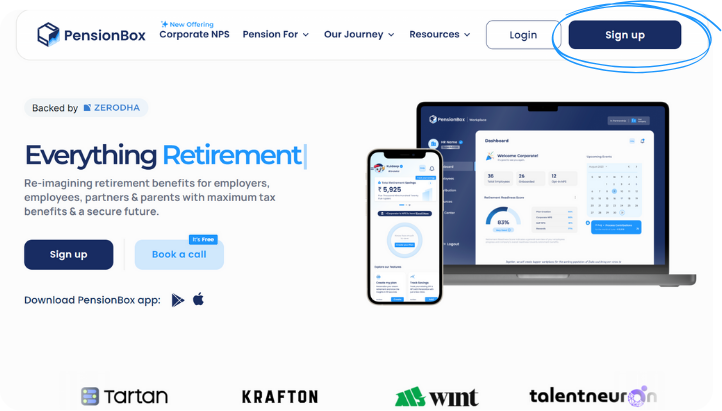
Step 1: Sign up
Open pensionbox.in and click Sign Up.
Step 2: Enter your mobile number

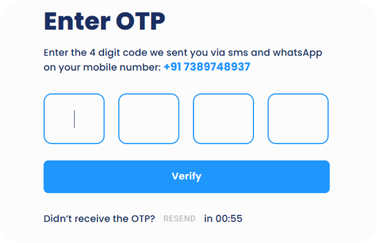
Step 3: Verify the OTP
You get a one-time password on SMS and WhatsApp. Enter it to continue.
Step 4: Choose Open NPS
Once you are verified, the dashboard offers Open NPS. Existing Zerodha Kite users get their KYC linked here, which skips most of the next step.

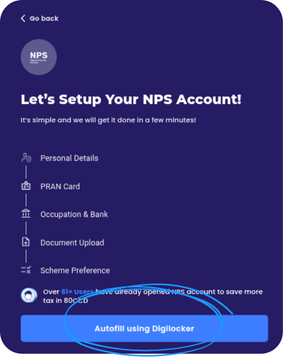
Step 5: Fill in your details, or autofill with DigiLocker
The account itself needs personal details, PRAN card, occupation and bank, documents and your scheme preference — pension fund and investment option. Autofill using DigiLocker pulls most of it for you.
Before you decide how much to contribute, run the number through the NPS calculator — the gap between ₹5,000 and ₹10,000 a month over 25 years is far larger than most people expect.
FAQs
Is NPS better than EPF?
They do different jobs. EPF is a fixed-rate, debt-only, employer-linked scheme; NPS is market-linked and gives you the choice of fund manager and equity exposure. Most salaried people end up with both, and there is no reason to pick one. See NPS vs EPF.
Can I claim 80CCD(2) in the new tax regime?
Yes. It is one of the few deductions the new regime keeps, up to 14% of basic + DA for private-sector employees — but it only applies to what your employer puts in, so your company has to offer Corporate NPS.
What return does NPS give?
There is no fixed or guaranteed rate. Returns depend on the pension fund and the asset mix you chose, and equity-heavy allocations swing with the market. Anyone quoting you a single guaranteed NPS return is quoting past performance.
What happens to my NPS if I change jobs?
Nothing — the PRAN is yours, not your employer's. It converts to an individual account and can be linked again under your next employer, with the corpus and history intact.
Can I withdraw before 60?
Yes, through premature exit, which no longer carries a minimum subscription period. If the corpus is ₹5 lakh or less you can take all of it; above that at least 80% must buy an annuity. There are also limited partial withdrawals for specified reasons.
Want your employer contributing to your NPS too? The 80CCD(2) deduction is the only one that survives the new tax regime, and it costs your company nothing extra. Show your HR PensionBox. See how Corporate NPS works →
2,00,000+ Stories
Hope they inspires you as well.

their NPS stories for a golden retirement.







PensionBox simplifies the National Pension System(NPS), the government's pension scheme for private employees both for retail users and HRs/companies.
If you don’t have an NPS account, you can simply open your pension account within 2 minutes and if you have NPS PRAN already, you will be able track, invest and manage everything free of charge with best user experience.
We never touch or hold your money directly, your investments go safely to your chosen pension fund through approved channels.
We are built with Zerodha as POP , ensuring transparency, data security, and peace of mind. Your retirement savings are protected by regulation and secured by technology.
That’s why, PensionBox brings transparency, zero charges, timely support and freedom to select any pension fund so that you get the best experience investing in NPS & be better future ready.
That’s not it, we help you & your company together to maximise contribution and tax savings with minimal charges & best user experience.
If you are an existing zerodha user then you get a fast login or sign up using kite ID.
Once you are onboarded with kite ID, you get free access to
- Open NPS in 2 minutes
- Track existing NPS
- POP shift or CRA shifting
- Invest in one time or create SIP in NPS
- Withdraw NPS requests & instant withdraw tier 2
- Create your dream retirement plan
- Open NPS Vatsalya for your kid
- Share with HR (To unlock more tax benefits)
- Employer Contribution:
- Contributions made by your employer to your NPS account are tax-free up to 14% of your basic salary under Section 80CCD(2). Do connect us with your HR to enable this for you.
Tax Benefits in Old Tax Regime - Self-Contribution:
- Deduction up to ₹1.5 lakh under Section 80C.
- Additional deduction of ₹50,000 under Section 80CCD(1B) — exclusive to NPS investments!
- This allows you to claim a total deduction of up to ₹2 lakh every year on your NPS contributions.
- Employer Contribution:
- Contributions made by your employer to your NPS account are tax-free up to 10% of your basic salary (Basic + DA) under Section 80CCD(2). Do connect us with your HR to enable this for you.
- This is over and above your personal deduction limits, giving you extra tax efficiency.
Feel free to book a free call to learn more about NPS, NPS Vatsalya, Corporate NPS & PensionBox or contact the support team.