
Lumpsum vs. SIP: What Really Determines Your Returns

What if the biggest investing mistake isn't picking the wrong fund, but picking the wrong day?
Take two people who invest the same amount and stay invested for the same three years. Neither picks better stocks. Neither takes bigger risks. Neither knows something the other doesn't. Yet one of them ends up far ahead of the other.
The only difference? How they put their money in all at once, or a little every month.
Why does this happen? Because for common investors like us the advice we always hear is:
"Buy low, sell high" And this gets repeated so often it starts to sound like wisdom until you realise it's really just "leave early to beat traffic" dressed up in financial language. True, obviously. Completely useless at the moment, because nobody can see the traffic or the market's "low" until they're already stuck in it. So what's the right call and how do you make it without needing to be a finance expert? Let's find out.
One Big Leap vs. Many Small Steps
Lumpsum: You invest one large amount, all at once. Your return depends heavily on where the market happens to be on that single day.
SIP (Systematic Investment Plan): You invest a smaller, fixed amount every month. You automatically buy more units when prices are low and fewer when prices are high without having to time anything yourself. Think of it as the difference between betting everything on one hand of cards versus playing several small hands over an evening.
One depends entirely on a single moment going your way. The other lets the wins and losses even out over time. (something also referred to as rupee cost averaging)
Round 1: The Calm Before the Storm (2004 2006)
Suppose you had ₹3.6 lakh to invest either all at once, or spread evenly across 36 months during a period when the market simply moved upward, with no major crash in between.
Lumpsum: ₹3,60,000 grew to ₹8,39,000 (2.33x) return
SIP: ₹3,60,000 grew to ₹5,60,000 (1.55x) return
Here, lumpsum wins clearly. Since the market kept climbing, every month you waited to invest through SIP meant buying at a slightly higher price than before.
The lumpsum investor locked in the lowest price on day one and simply let it ride. In a market that only goes up, going in early and in full pays off.
Round 2: When the Storm Actually Hits (2008 – 2010)
Now the harder case. Same ₹3.6 lakh, same 36-month window except this time, you start right when the market is near its peak in January 2008. It falls sharply through the year, before slowly clawing its way back by the end of 2010.
1. Lumpsum: ₹3,60,000 grew to only ₹3,69,000 (1.03x return)
2. SIP: ₹3,60,000 grew to ₹5,94,000 (1.65x return)
This time, the result flips completely. The lumpsum investor happened to enter at the worst possible moment and barely broke even after three full years. The SIP investor kept investing straight through the downturn quietly buying units at much lower prices during the crash which paid off handsomely once the market recovered.
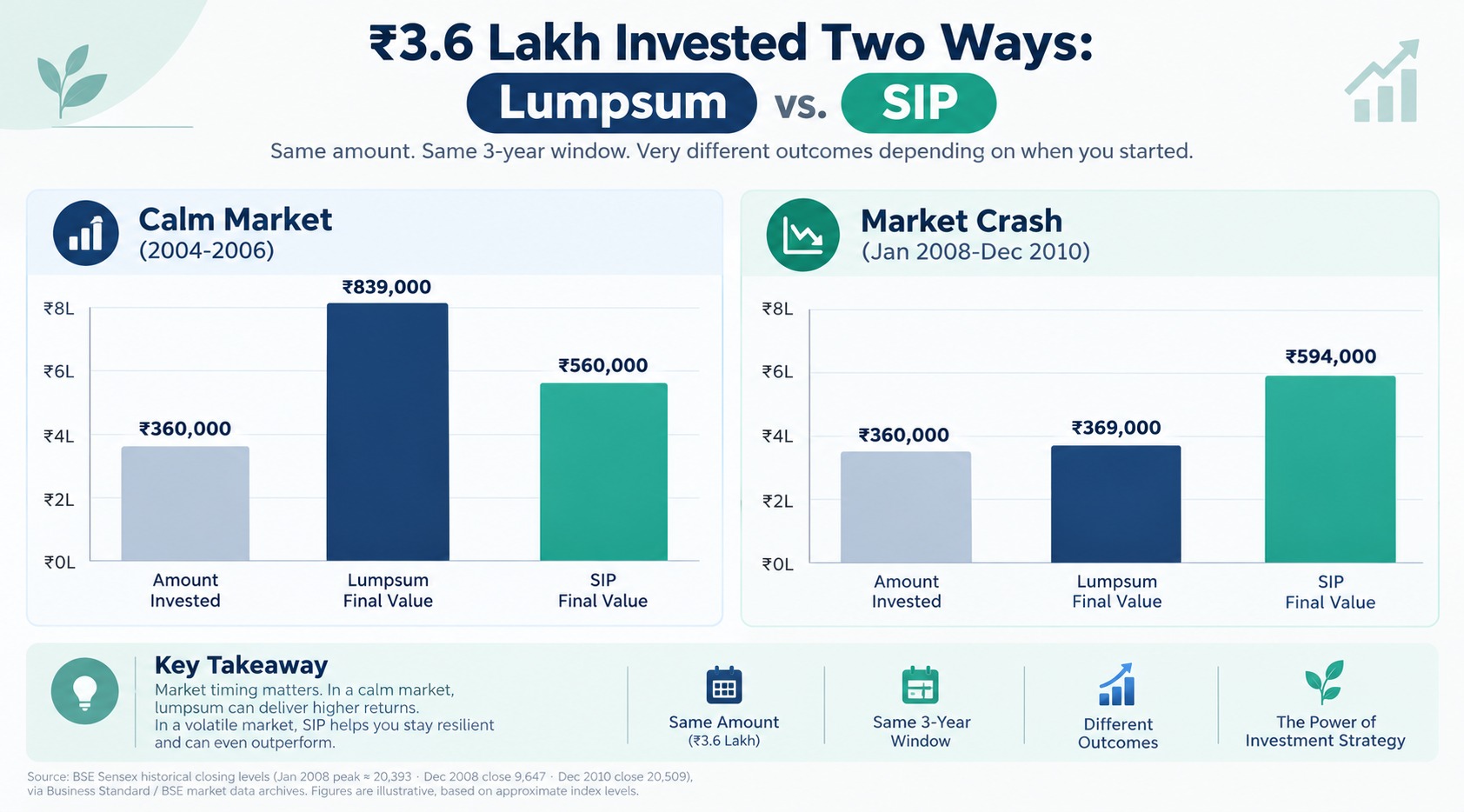
(Figures are based Business Standard's market archives and BSE historical data.)
The Verdict: Does Timing Actually Matter?
Yes enormously. And that's exactly the problem. Because only in retrospect do we all become experts.
Round 2 shows that getting your entry timing wrong can mean years of going nowhere, even while staying invested the whole time.
And since nobody can know in advance whether they're stepping into a "2004" market or a "2008" market, betting everything on perfect timing is closer to a coin toss than a strategy.
SIP doesn't try to predict any of this. It simply keeps you invested consistently, letting the highs and the lows average out which, over long periods, tends to matter far more than being right on any single day.
Okay, So What Should You Actually Do?
Knowing this is only useful if it changes what you do next. A few practical takeaways:
1. If you're investing a large one-time amount (bonus, inheritance, maturity payout), don't assume lumpsum is automatically "better" just because it worked in Round 1, consider your time horizon and comfort with short-term drops before going all in.
2. If you're investing from a regular income, a SIP naturally matches how money actually enters your life one salary at a time and removes the pressure of deciding "is this a good day to invest?"
3. If you're unsure which market you're stepping into, default to SIP. It's designed for exactly this uncertainty.
4. Review your existing contributions, many people set up an SIP once and never check whether the amount still matches their income or goals years later. A five-minute review once or twice a year is enough.
The Long Game: Why This Matters Even More for Retirement
Retirement savings are really this same experiment, played out over decades instead of three years funded by monthly income, not a one-time windfall.
That's exactly the shape a SIP is built for, and it's also the logic behind retirement instruments like the National Pension System (NPS), which is structured around regular monthly contributions rather than a single decision that has to be perfectly timed.
It's also why platforms like PensionBox are built around helping you track that kind of steady, month-on-month contribution whether it's flowing into your NPS account or other retirement savings instead of leaving it to a single moment you're expected to get right.
The market will always have its 2004s and its 2008s. The only part you actually control is whether you keep showing up in between.
2,00,000+ Stories
Hope they inspires you as well.

their NPS stories for a golden retirement.







PensionBox simplifies the National Pension System(NPS), the government's pension scheme for private employees both for retail users and HRs/companies.
If you don’t have an NPS account, you can simply open your pension account within 2 minutes and if you have NPS PRAN already, you will be able track, invest and manage everything free of charge with best user experience.
We never touch or hold your money directly, your investments go safely to your chosen pension fund through approved channels.
We are built with Zerodha as POP , ensuring transparency, data security, and peace of mind. Your retirement savings are protected by regulation and secured by technology.
That’s why, PensionBox brings transparency, zero charges, timely support and freedom to select any pension fund so that you get the best experience investing in NPS & be better future ready.
That’s not it, we help you & your company together to maximise contribution and tax savings with minimal charges & best user experience.
If you are an existing zerodha user then you get a fast login or sign up using kite ID.
Once you are onboarded with kite ID, you get free access to
- Open NPS in 2 minutes
- Track existing NPS
- POP shift or CRA shifting
- Invest in one time or create SIP in NPS
- Withdraw NPS requests & instant withdraw tier 2
- Create your dream retirement plan
- Open NPS Vatsalya for your kid
- Share with HR (To unlock more tax benefits)
- Employer Contribution:
- Contributions made by your employer to your NPS account are tax-free up to 14% of your basic salary under Section 80CCD(2). Do connect us with your HR to enable this for you.
Tax Benefits in Old Tax Regime - Self-Contribution:
- Deduction up to ₹1.5 lakh under Section 80C.
- Additional deduction of ₹50,000 under Section 80CCD(1B) — exclusive to NPS investments!
- This allows you to claim a total deduction of up to ₹2 lakh every year on your NPS contributions.
- Employer Contribution:
- Contributions made by your employer to your NPS account are tax-free up to 10% of your basic salary (Basic + DA) under Section 80CCD(2). Do connect us with your HR to enable this for you.
- This is over and above your personal deduction limits, giving you extra tax efficiency.
Feel free to book a free call to learn more about NPS, NPS Vatsalya, Corporate NPS & PensionBox or contact the support team.