NPS Vs ELSS Vs Mutual Funds ? How To Choose ?

When planning your finances, NPS, ELSS, and Mutual Funds are three investment options worth comparing. They are commonly considered by individuals looking to build long-term wealth, plan for retirement, or benefit from available tax deductions. While all three offer opportunities to grow your money through market-linked investments, they differ in their objectives, investment choices, withdrawal rules, and tax treatment.
Choosing between them is not just about comparing potential returns. It is also about understanding how each investment works, how long your money needs to remain invested, and how easily you can access it when needed.
National Pension System (NPS)
What Is NPS?
The National Pension System (NPS) is a market-linked retirement savings scheme that helps individuals build a retirement corpus through regular contributions during their working years.
Your money can be invested across asset classes such as equity, corporate debt, and government securities. Returns depend on market performance, asset allocation, and applicable charges. Returns are not guaranteed.
Regulation
NPS is regulated by the Pension Fund Regulatory and Development Authority (PFRDA).
Lock-in and Withdrawal Rules
NPS is designed for retirement, so withdrawals depend on the account type, subscriber category, and applicable exit conditions.
For eligible subscribers, normal exit is generally available after 15 years of subscription or upon attaining age 60, whichever comes first, subject to applicable rules.
- Corpus up to ₹8 lakh: The entire corpus can generally be withdrawn as a lump sum or through permitted systematic withdrawal options.
- Corpus above ₹8 lakh and up to ₹12 lakh: Up to ₹6 lakh can generally be withdrawn as a lump sum, with the balance going into SWP (Systematic Withdrawal Plan).
- Corpus above ₹12 lakh: Up to 80% can generally be withdrawn as a lump sum out of which 60% is completely tax free and 20% is taxed only if it falls under the applicable tax slabs, and the rest 20% goes into annuity.
Premature exits, partial withdrawals, and government-sector accounts may follow different rules. Always check the applicable NPS guidelines before making a withdrawal.
Taxation Treatment
At Exit
- As discussed above, there is a taxable section under the applicable rules, click here to know more about how this taxation works
During Investment
- NPS offers tax benefits on eligible contributions, depending on the tax regime selected and the applicable conditions.
Old Tax Regime
- Section 80CCD(1): Eligible personal contributions qualify within the overall ₹1.5 lakh deduction limit.
- Section 80CCD(1B): An additional deduction of up to ₹50,000 may be available for eligible personal NPS contributions
- Section 80CCD(2): Corporate NPS benefits of upto 10% of basic salary + DA can be claimed as a deduction.
New Tax Regime
Only the Corporate NPS deductions are available under Section 80 CCD(2)
- Section 80CCD(2): Corporate NPS benefits of upto 14% of basic salary + DA can be claimed as a deduction.
Investment Choices
NPS offers three major asset classes:
- Equity (E): Invests in company shares and offers growth potential with market risk.
- Corporate Debt (C): Invests in corporate bonds and other eligible debt instruments.
- Government Securities (G): Invests in government securities and carries interest-rate risk.
Best suited for: Individuals looking to build retirement savings through a structured, long-term investment with access to eligible tax benefits.
Equity Linked Savings Scheme (ELSS)
What Is ELSS?
An Equity Linked Savings Scheme (ELSS) is an equity mutual fund that invests predominantly in equities. It offers the potential for long-term wealth creation and a tax deduction under Section 80C for eligible investors under the old tax regime.
Regulation
ELSS funds are regulated by the Securities and Exchange Board of India (SEBI).
Lock-in and Withdrawal Rules
ELSS has a mandatory three-year lock-in period for each investment.
For SIP investments, every instalment has its own three-year lock-in period. Once the lock-in period for an instalment ends, you can redeem those units or remain invested.
Taxation Treatment
At Exit
- Gains on eligible units held for more than 12 months are considered long term capital gains and are generally taxed at 12.5% on gains exceeding ₹1.25 lakh in a financial year.
During Investment
- Section 80C: Eligible investments qualify for a deduction within the overall ₹1.5 lakh annual limit under the old tax regime.
Applicable surcharge and cess may also apply. Tax treatment depends on the relevant provisions and your circumstances.
Investment Choices
ELSS funds invest predominantly in equities. You can invest through a lump sum or a Systematic Investment Plan (SIP).
Best suited for: Investors seeking equity exposure who can remain invested for at least three years and qualify for the Section 80C deduction under the old tax regime.
Mutual Funds (Other Than ELSS)
What Is a Mutual Fund?
A mutual fund pools money from multiple investors and invests it in assets such as shares, bonds, and money-market instruments.
Different mutual fund categories serve different financial goals, including long-term wealth creation, income generation, and portfolio diversification.
Regulation
Mutual funds are regulated by SEBI.
Lock-in and Withdrawal Rules
Most open-ended mutual funds do not have a mandatory lock-in period. You can generally redeem your units subject to the scheme's terms, settlement timelines, and any applicable exit load.
An exit load is a fee charged when units are redeemed within a specified period. Some mutual fund schemes may have lock-in periods or other redemption restrictions.
Taxation Treatment
At Exit
- Equity-oriented funds: Eligible short-term capital gains are generally taxed at 20%, while eligible long-term capital gains are generally taxed at 12.5% on aggregate gains exceeding ₹1.25 lakh in a financial year.
- Debt-oriented funds: Tax treatment depends on the fund's classification and acquisition date. Certain specified debt-oriented funds acquired on or after 1 April 2023 are generally taxed at the investor's applicable income-tax slab rate under the relevant provisions.
- IDCW distributions: Income received under the Income Distribution cum Capital Withdrawal (IDCW) option is generally taxable at the investor's applicable income-tax rate.
Applicable surcharge and cess may also apply. Tax rules can differ across mutual fund categories, so investors should check the rules applicable to their specific investment.
During Investment
- Mutual Funds do not offer a tax deduction simply for investing. Taxation depends on the fund category, acquisition date, holding period, and applicable tax provisions.
Investment Choices
Mutual funds offer a wide range of investment categories:
- Equity funds: Primarily invest in shares.
- Debt funds: Invest in bonds and money-market instruments.
- Hybrid funds: Combine equity and debt investments.
- Index funds: Track a market index through a passive investment strategy.
- Sectoral and thematic funds: Focus on particular industries or investment themes.
Best suited for: Investors who want flexibility and a range of investment options for different financial goals, time horizons, and risk preferences.
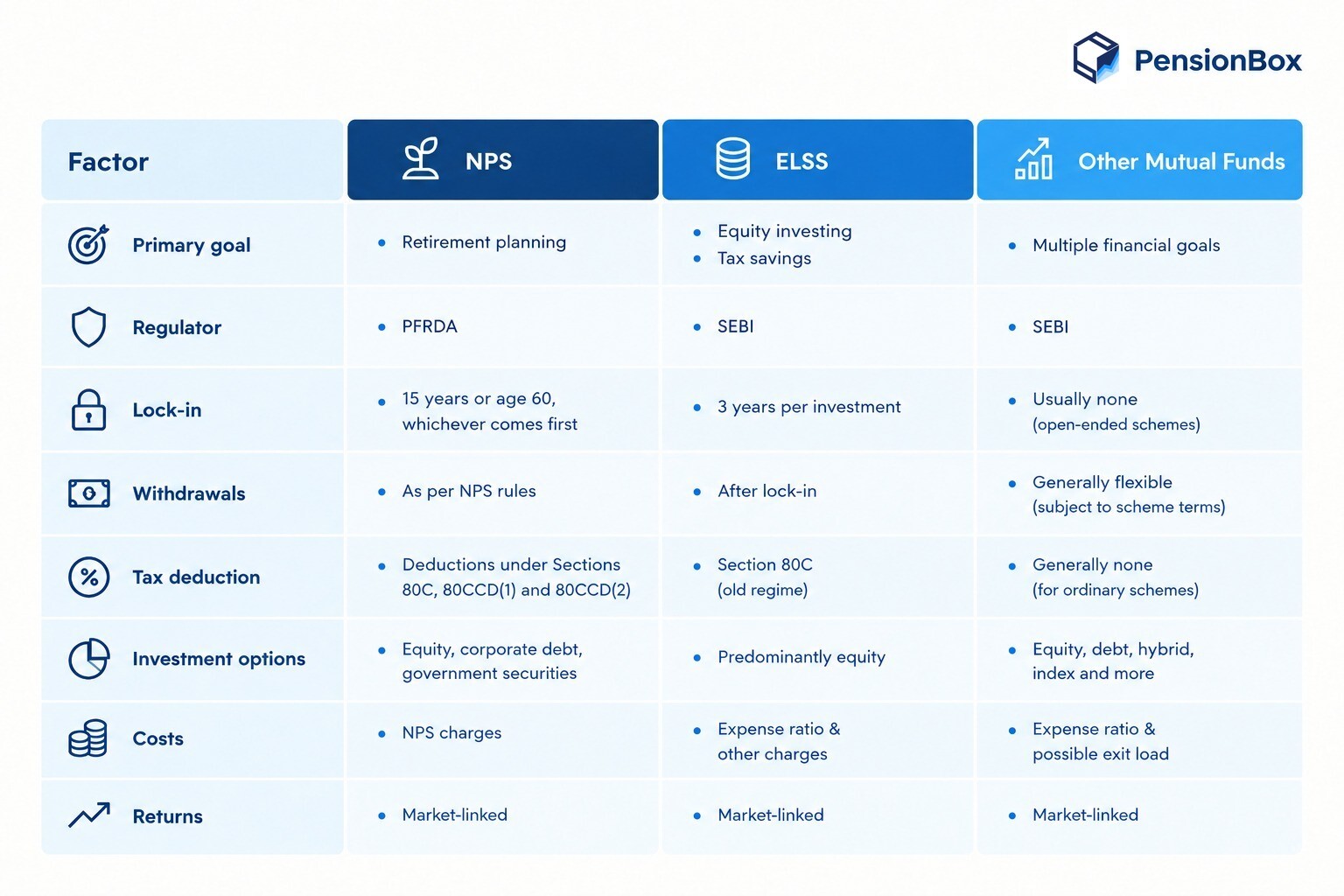
COMPARISON TABLE
Ready to Take the Next Step Towards Retirement ?
Choosing the right investment option depends on your retirement goals, investment horizon, risk appetite, liquidity needs, and tax situation. While NPS is designed for retirement planning, ELSS and other mutual funds can help you pursue different financial goals. Understanding these differences can help you make informed decisions and build a retirement plan that works for you.
- ELSS: If you want equity exposure with a 3-year lock-in and tax benefits, but available only under the old tax regime, consider ELSS
- Mutual Funds: If you want greater flexibility, a wide range of investment options, and generally no lock-in, explore mutual funds.
- NPS: If you want to build a retirement corpus through a structured, long-term investment with potential tax benefits, consider NPS.
With PensionBox, backed by Zerodha, you can open your NPS account and book a call for free retirement planning to help you understand your future financial needs and plan towards your retirement goals.
2,00,000+ Stories
Hope they inspires you as well.

their NPS stories for a golden retirement.







PensionBox simplifies the National Pension System(NPS), the government's pension scheme for private employees both for retail users and HRs/companies.
If you don’t have an NPS account, you can simply open your pension account within 2 minutes and if you have NPS PRAN already, you will be able track, invest and manage everything free of charge with best user experience.
We never touch or hold your money directly, your investments go safely to your chosen pension fund through approved channels.
We are built with Zerodha as POP , ensuring transparency, data security, and peace of mind. Your retirement savings are protected by regulation and secured by technology.
That’s why, PensionBox brings transparency, zero charges, timely support and freedom to select any pension fund so that you get the best experience investing in NPS & be better future ready.
That’s not it, we help you & your company together to maximise contribution and tax savings with minimal charges & best user experience.
If you are an existing zerodha user then you get a fast login or sign up using kite ID.
Once you are onboarded with kite ID, you get free access to
- Open NPS in 2 minutes
- Track existing NPS
- POP shift or CRA shifting
- Invest in one time or create SIP in NPS
- Withdraw NPS requests & instant withdraw tier 2
- Create your dream retirement plan
- Open NPS Vatsalya for your kid
- Share with HR (To unlock more tax benefits)
- Employer Contribution:
- Contributions made by your employer to your NPS account are tax-free up to 14% of your basic salary under Section 80CCD(2). Do connect us with your HR to enable this for you.
Tax Benefits in Old Tax Regime - Self-Contribution:
- Deduction up to ₹1.5 lakh under Section 80C.
- Additional deduction of ₹50,000 under Section 80CCD(1B) — exclusive to NPS investments!
- This allows you to claim a total deduction of up to ₹2 lakh every year on your NPS contributions.
- Employer Contribution:
- Contributions made by your employer to your NPS account are tax-free up to 10% of your basic salary (Basic + DA) under Section 80CCD(2). Do connect us with your HR to enable this for you.
- This is over and above your personal deduction limits, giving you extra tax efficiency.
Feel free to book a free call to learn more about NPS, NPS Vatsalya, Corporate NPS & PensionBox or contact the support team.