
What is NPS Vatsalya Scheme? Eligibility, How to Open, Returns

NPS Vatsalya — often called NPS for kids — is a pension scheme for children under 18, run under the National Pension System (NPS) and regulated by PFRDA. A parent or legal guardian opens the account in the child's name with as little as ₹250, invests in a market-linked fund chosen from PFRDA-registered Pension Funds, and operates the account until the child turns 18. This guide covers everything about the NPS Vatsalya scheme in one place: its objective, eligibility, documents, how to open the account online, contributions, returns, charges, withdrawals, tax benefits and what happens when your child becomes an adult.
NPS Vatsalya at a glance
| Feature | Details |
|---|---|
| Launched | 18 September 2024 (announced in the Union Budget 2024-25) |
| Regulator | PFRDA, under the NPS Vatsalya Scheme Guidelines 2025 |
| Who can join | Indian citizens below 18 years, including eligible NRIs and OCIs |
| Account holder | The child is the subscriber; a parent or legal guardian operates the account until 18 |
| Minimum contribution | ₹250 at opening and ₹250 in each financial year |
| Maximum contribution | No limit |
| Returns | Market-linked; no fixed or guaranteed interest rate |
| Partial withdrawal | Up to 25% of own contributions, after 3 years, for education, specified illnesses or disability |
| At 18 | Continue up to 21, shift the corpus to regular NPS, or exit |
| Tax benefit | Up to ₹50,000 deduction for the parent under Section 80CCD(1B), old tax regime only |
What is the NPS Vatsalya scheme?
NPS Vatsalya is a pension scheme for children below 18 under the National Pension System, regulated by PFRDA. A parent or legal guardian opens the account in the child's name with as little as ₹250, a PFRDA-registered Pension Fund invests it in market-linked assets, and the child takes charge of the account at 18. It was announced in the Union Budget 2024-25 and launched by the Government of India on 18 September 2024. It is covered under the National Pension System under sections 12(1)(a) and 20 of the PFRDA Act, 2013, and governed by the NPS Vatsalya Scheme Guidelines 2025.
The child is the subscriber and the only beneficiary. A Permanent Retirement Account Number (PRAN) is issued in the child's name, while the parent or legal guardian operates the account until the child turns 18. After that, the account passes to the child.
What is the primary objective of the NPS Vatsalya scheme?
The primary objective of the NPS Vatsalya scheme is to help parents build long-term financial security for their child from an early age. PFRDA says the scheme promotes early saving, financial literacy and financial planning for minors, while the NPS Trust FAQs add the aim of a disciplined saving habit and a head start on the child's retirement corpus.
NPS Vatsalya is different from Mission Vatsalya, which is a child-protection scheme of the Ministry of Women and Child Development. The two share a name but are unrelated.
Who is eligible for NPS Vatsalya?
-
Age: Any Indian citizen below 18 years of age can have an NPS Vatsalya account.
-
NRIs and OCIs: Under PFRDA rules, eligible NRI and OCI minors can also be enrolled; an NRE or NRO bank account is then mandatory. PensionBox currently opens NPS Vatsalya accounts for resident Indian families.
-
Gender: The scheme is gender-neutral and open to boys and girls alike.
-
Who opens it: A parent or legal guardian opens and operates the account. The parent does not need an NPS account of their own and does not need to be a government employee. A grandparent can open the account only if they are the child's legal guardian. The guardian automatically becomes the nominee, so no separate nomination is needed at opening. A court-appointed legal guardian must submit a copy of the court order along with their KYC documents.
-
One account per child: Only one NPS Vatsalya account can be opened for a child.
Documents required for NPS Vatsalya
| For | Documents |
|---|---|
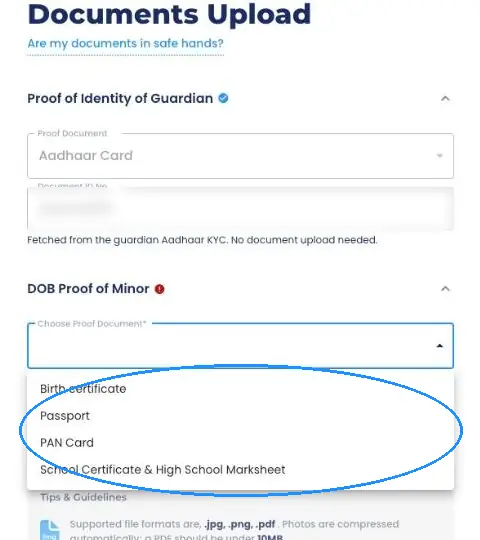
| Child | Proof of date of birth: birth certificate, school leaving certificate, matriculation certificate, PAN or passport |
| Parent / legal guardian | KYC document such as Aadhaar, driving licence, passport, voter ID, NREGA job card or National Population Register document, along with PAN or Form 60 |
| Bank account | Optional for resident Indians at opening; needed later for withdrawals and exit |
How to open an NPS Vatsalya account online: registration process
You can apply for NPS Vatsalya online and open the account for your child with PensionBox in a few minutes:
- Sign up on PensionBox with the parent's or guardian's mobile number.
- Complete the parent's or guardian's KYC online.
- Keep the child's date-of-birth proof ready, such as the birth certificate.
- Fill out the NPS Vatsalya form and choose the Pension Fund.
- Make the first contribution of at least ₹250.
Here is what each step looks like on PensionBox:
- Sign up on PensionBox: Create an account in seconds.
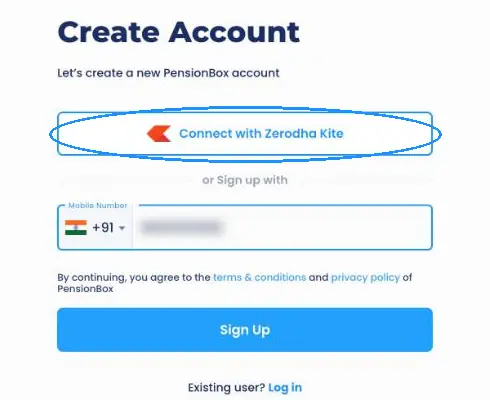
- Complete your KYC: If you have a Zerodha account, you can connect it to use your existing KYC; otherwise finish the PAN check and Aadhaar e-sign online.

-
Keep your child's date-of-birth proof handy: birth certificate, passport, PAN card or school certificate.
-
Fill out the NPS form: It takes less than 5 minutes. You choose the Pension Fund that will invest your child's money.
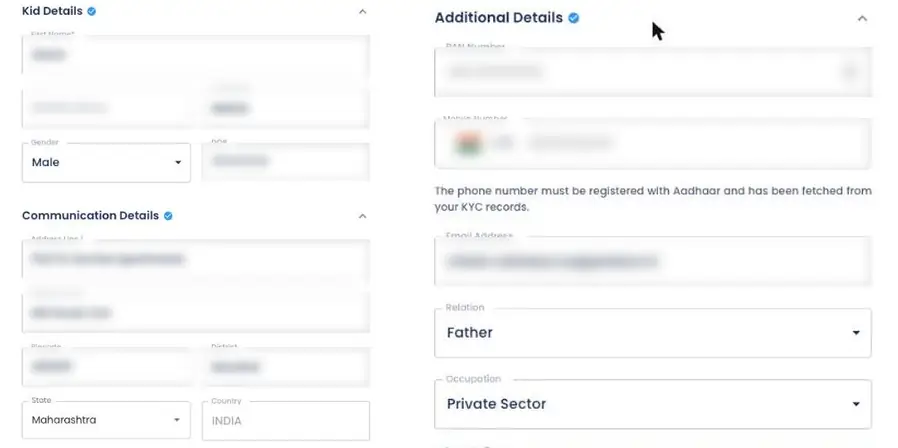
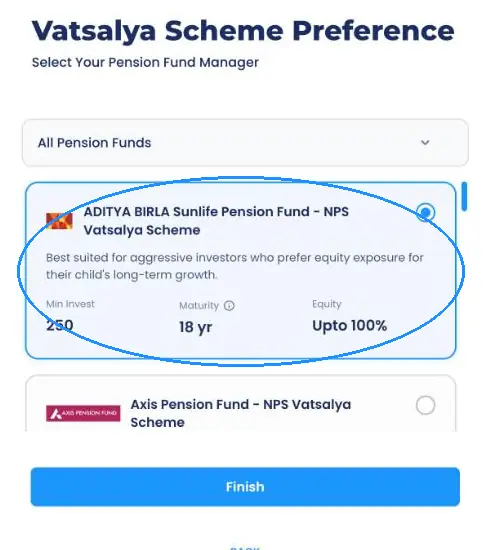
- Make the first contribution: Start with as little as ₹250.
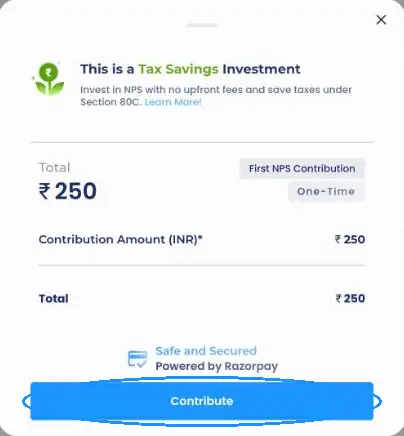
Once the account is opened, a PRAN is issued in your child's name, and you can add contributions and track the account online. The account can also be opened offline through a Point of Presence registered with PFRDA.
Which agency issues the PRAN for NPS Vatsalya?
The PRAN for an NPS Vatsalya account is issued by a Central Recordkeeping Agency (CRA) registered with PFRDA. The CRA keeps the records of every NPS account; the guardian selects a CRA and a Pension Fund when the account is opened. The PRAN is issued in the minor's name.
How much can you invest in NPS Vatsalya?
The minimum contribution is ₹250 at the time of opening and ₹250 in each financial year. After that, a single contribution can be as small as ₹10, and there is no limit on the number of contributions in a year or on the total amount. Parents, guardians, relatives and friends can all contribute to the child's account. If a year's minimum is missed, the account does not close automatically.
Read more about the minimum investment and the maximum contribution, or estimate the corpus with the NPS Vatsalya calculator.
How are NPS Vatsalya contributions invested, and what returns can you expect?
Contributions are invested by the PFRDA-registered Pension Fund you choose. Pension Funds may design their own NPS Vatsalya schemes with up to 100% in equity, or follow an indicative pattern with up to 75% in equity, 20% in government securities, 30% in debt instruments and 10% in money market instruments. You can change the Pension Fund once in a financial year.
NPS Vatsalya does not pay a fixed interest rate. Returns are market-linked and depend on the performance of the Pension Fund and its scheme, so they can vary from year to year and are not guaranteed. Over a horizon of 18 years or more, a higher equity share gives more room for growth, along with bigger short-term ups and downs. See our detailed note on NPS Vatsalya interest rates and returns.
What are the charges for NPS Vatsalya?
Charges are the same as for the NPS All Citizen model. Under PFRDA's charge structure effective 1 October 2026, a Point of Presence can charge up to ₹200 per PRAN for onboarding (a reduced charge of ₹100 may apply for fully digital onboarding), plus 0.20% of the account value a year. The Central Recordkeeping Agency charges up to ₹18 for an e-PRAN kit (₹40 for a physical card) and an annual maintenance charge that rises with the corpus, from nil for an empty account to a maximum of ₹500 a year. The Pension Fund's investment management fee is separate and is capped by PFRDA at 0.12% a year or lower, depending on the fund's size.
Benefits of NPS Vatsalya
-
Early start: An account opened at birth gets 18 years or more of compounding before the child even becomes an adult.
-
Low entry amount: The scheme can be started with ₹250, and there is no upper limit as the family's income grows.
-
Growth-oriented investment: Pension Funds can offer up to 100% equity for a long-horizon child account.
-
Low cost: PFRDA caps the charges, so more of the money stays invested.
-
Withdrawals for the child's needs: Partial withdrawals are allowed for education, specified illnesses and disability.
-
Tax benefit: Parents in the old tax regime can claim a deduction of up to ₹50,000 a year.
-
Financial habit: The child grows up with a savings account in their own name and takes charge of it at 18.
For a balanced view of the trade-offs, read our guide to the pros and cons of NPS Vatsalya.
Can you withdraw from NPS Vatsalya before 18?
Only partially. After 3 years from opening, you can withdraw up to 25% of your own contributions (not the returns) for the child's education, treatment of specified illnesses, or disability of more than 75%. Up to two such withdrawals are allowed before the child turns 18, and two more between 18 and 21. The account cannot be closed for a full withdrawal before 18. See the full NPS Vatsalya withdrawal rules and the lock-in period.
What happens to NPS Vatsalya when the child turns 18?
At 18, the child completes fresh KYC and gives nominee details, and the management of the account passes to them. The child then chooses one of these options:
| Option | What happens |
|---|---|
| Continue in NPS Vatsalya | The account can stay in the scheme up to age 21 |
| Shift to regular NPS | The entire corpus moves to an NPS account after KYC |
| Exit, corpus below ₹8 lakh | The entire corpus can be withdrawn as a lump sum |
| Exit, corpus ₹8 lakh or more | Up to 80% as a lump sum; at least 20% must buy an annuity |
| No choice made by 21 | Moved automatically to a higher-equity scheme of the same Pension Fund, under regular NPS rules |
If the KYC is not completed after the child turns 18, no further transactions are allowed until the child turns 21, after which the account becomes dormant. Some older articles still mention a 3-month KYC deadline, an 80% annuity rule and a ₹2.5 lakh exit limit; those were replaced by the NPS Vatsalya Scheme Guidelines 2025 and the rules above.
More on this in what happens when your child turns 18 under NPS Vatsalya.
What are the tax benefits of NPS Vatsalya?
Under the old tax regime, a parent or guardian can claim a deduction of up to ₹50,000 a year for contributions to the child's NPS Vatsalya account under Section 80CCD(1B) of the Income-tax Act, 1961 (Section 124(4) of the Income-tax Act, 2025). This is the same ₹50,000 limit that covers the parent's own NPS contributions under 80CCD(1B) (Income Tax Department). There is no deduction under the new tax regime.
Partial withdrawals of up to 25% of contributions are tax-exempt under both regimes, and at exit, a lump sum of up to 60% of the corpus is tax-exempt. If the minor subscriber dies, the amount received by the parent, guardian or nominee is not treated as their income. Read the full breakdown of NPS Vatsalya tax benefits.
Frequently asked questions
Is NPS Vatsalya a good investment for my child?
It suits parents who want to build a long-term corpus for their child and can leave the money invested until the child turns 18. It is market-linked, so returns are not guaranteed. Our NPS Vatsalya vs Sukanya Samriddhi Yojana comparison helps if you are choosing between the two; a child can also hold both.
What are the key facts about NPS Vatsalya for UPSC and other exams?
NPS Vatsalya was announced in the Union Budget 2024-25 and launched on 18 September 2024. It is regulated by PFRDA under sections 12(1)(a) and 20 of the PFRDA Act, 2013, and governed by the NPS Vatsalya Scheme Guidelines 2025. It is open to Indian citizens below 18, with a minimum contribution of ₹250 a year, and its objective is to build long-term financial security for minors.
Can I open more than one NPS Vatsalya account for my child?
No. Only one NPS Vatsalya account can be opened for a child.
Can grandparents contribute to NPS Vatsalya?
Yes. Grandparents, relatives and friends can contribute to the child's account. A grandparent can open the account only if they are the child's legal guardian.
What happens if the guardian or the child dies?
If the guardian dies, a new guardian is registered with fresh KYC and the account continues. If the child dies, the entire accumulated amount is paid to the guardian, nominee or legal heir, and it is not treated as their income for tax.
Can I set up a monthly SIP in NPS Vatsalya?
Yes, regular contributions can be set up; read how an NPS Vatsalya SIP works.
Can I change the Pension Fund, CRA or Point of Presence later?
Yes. The Point of Presence can be changed at any time, the Pension Fund once in a financial year, and the Central Recordkeeping Agency twice in a financial year.
How can I track my child's NPS Vatsalya account?
Log in to the account online or through the mobile app provided by the CRA or Point of Presence, and check the Statement of Transactions, which shows contributions and investment performance. The CRA also sends periodic statements to the registered email ID.
How do I raise a complaint about an NPS Vatsalya account?
Lodge it on Pension Sahayak, PFRDA's grievance portal, or the CRA's Central Grievance Management System. The intermediary must resolve it within 30 days. If you are not satisfied, it can be escalated to NPS Trust, then the Ombudsman, PFRDA and the Securities Appellate Tribunal.
What is the age limit for NPS Vatsalya?
The account is for children below 18 years; an existing account can continue in the scheme up to 21. See the NPS Vatsalya age limit for details.
Conclusion
NPS Vatsalya lets you start a pension account for your child with as little as ₹250 a year, invest it in a low-cost, market-linked fund, and give the child 18 years or more of compounding before they take charge of it. Withdrawals are limited until 18, and the tax benefit applies only in the old regime, so it works best as long-term money for your child's future. You can open an NPS Vatsalya account for your child online with PensionBox in a few minutes.
PensionBox helps families open and manage NPS accounts, and the steps above show our own sign-up flow. This guide is for general information and is not investment advice. Rules are as per the PFRDA NPS Vatsalya page and the NPS Trust FAQs updated 16 June 2026; returns are market-linked and not guaranteed. Last updated: 9 October 2026.
2,00,000+ Stories
Hope they inspires you as well.

their NPS stories for a golden retirement.







PensionBox simplifies the National Pension System(NPS), the government's pension scheme for private employees both for retail users and HRs/companies.
If you don’t have an NPS account, you can simply open your pension account within 2 minutes and if you have NPS PRAN already, you will be able track, invest and manage everything free of charge with best user experience.
We never touch or hold your money directly, your investments go safely to your chosen pension fund through approved channels.
We are built with Zerodha as POP , ensuring transparency, data security, and peace of mind. Your retirement savings are protected by regulation and secured by technology.
That’s why, PensionBox brings transparency, zero charges, timely support and freedom to select any pension fund so that you get the best experience investing in NPS & be better future ready.
That’s not it, we help you & your company together to maximise contribution and tax savings with minimal charges & best user experience.
If you are an existing zerodha user then you get a fast login or sign up using kite ID.
Once you are onboarded with kite ID, you get free access to
- Open NPS in 2 minutes
- Track existing NPS
- POP shift or CRA shifting
- Invest in one time or create SIP in NPS
- Withdraw NPS requests & instant withdraw tier 2
- Create your dream retirement plan
- Open NPS Vatsalya for your kid
- Share with HR (To unlock more tax benefits)
- Employer Contribution:
- Contributions made by your employer to your NPS account are tax-free up to 14% of your basic salary under Section 80CCD(2). Do connect us with your HR to enable this for you.
Tax Benefits in Old Tax Regime - Self-Contribution:
- Deduction up to ₹1.5 lakh under Section 80C.
- Additional deduction of ₹50,000 under Section 80CCD(1B) — exclusive to NPS investments!
- This allows you to claim a total deduction of up to ₹2 lakh every year on your NPS contributions.
- Employer Contribution:
- Contributions made by your employer to your NPS account are tax-free up to 10% of your basic salary (Basic + DA) under Section 80CCD(2). Do connect us with your HR to enable this for you.
- This is over and above your personal deduction limits, giving you extra tax efficiency.
Feel free to book a free call to learn more about NPS, NPS Vatsalya, Corporate NPS & PensionBox or contact the support team.